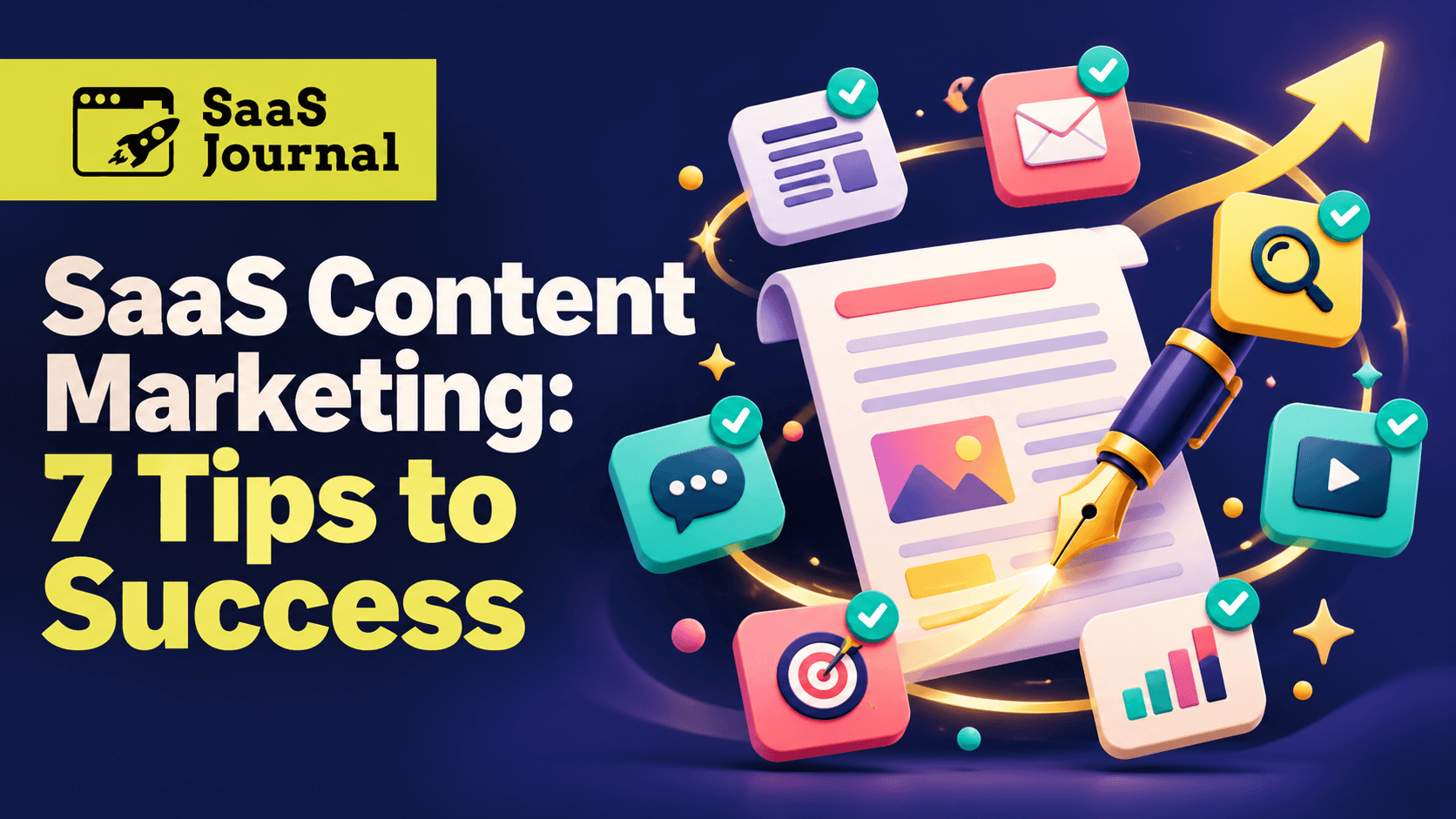
SaaS Content Marketing: 7 Tips to Success
Discover 7 proven SaaS content marketing tips to increase organic traffic, generate qualified leads, improve SEO, and drive business growth in 2026.
SaaS content marketing is the process of creating and distributing valuable content to attract, educate, convert, and retain software customers. The seven tips are: understand your customers, target relevant keywords, create helpful content, align it with the customer journey, use AI responsibly, promote your content, and measure results. Focus on resources that solve real customer problems rather than content produced solely to increase website traffic.
Content marketing has become one of the most important growth strategies for Software-as-a-Service (SaaS) companies.
Unlike traditional businesses that focus primarily on one-time purchases, SaaS companies depend on recurring subscriptions, customer retention, and long-term relationships.
This makes content marketing particularly valuable.
High-quality content helps SaaS businesses educate potential customers, demonstrate product value, generate qualified leads, and build trust throughout the customer journey.
However, publishing blog posts alone is not enough to produce meaningful results.
Successful SaaS content marketing requires a clear strategy, an understanding of customer needs, effective search engine optimization, and consistent performance measurement.
In 2026, artificial intelligence and evolving search experiences are also changing how customers discover software solutions.
SaaS companies must therefore create content that provides genuine value while supporting measurable business objectives.
Here are seven proven SaaS content marketing tips to help businesses attract the right audience, improve conversions, and achieve sustainable growth.
What Is SaaS Content Marketing?
SaaS content marketing is the process of creating and distributing valuable content to attract, educate, convert, and retain software customers.
Unlike traditional promotional advertising, content marketing focuses on answering customer questions and helping users solve problems.
Common SaaS content formats include:
-
Educational blog posts.
-
Product tutorials.
-
Comparison articles.
-
Customer case studies.
-
Whitepapers and guides.
-
Webinars.
-
Email newsletters.
-
Video demonstrations.
-
Industry research reports.
For example, a project management SaaS company might publish an article explaining how to improve team collaboration.
The article attracts readers interested in solving that problem and introduces the company's software as a potential solution.
An effective content marketing strategy connects educational resources with the needs of potential customers.
According to HubSpot's content marketing strategy guide, businesses can use relevant content to attract audiences and support customer relationships.
For SaaS companies, the goal is not simply generating website traffic. It is attracting people who may eventually benefit from the product.
Why Content Marketing Matters for SaaS Growth
SaaS buyers often research multiple solutions before making purchasing decisions.
They may read product comparisons, watch demonstrations, review pricing, and evaluate customer testimonials.
Content marketing helps companies reach these buyers during the research process.
Potential benefits include:
Increased Organic Visibility
Search-optimized content can help businesses appear in relevant search results.
Qualified Lead Generation
Educational content attracts users interested in problems the software solves.
Customer Education
Tutorials and product guides help customers understand software features.
Improved Customer Retention
Helpful resources encourage existing customers to use products more effectively.
Stronger Brand Authority
Original insights and industry expertise help SaaS companies establish credibility.
These benefits make content marketing an important component of long-term SaaS growth.
However, results depend on content quality, competition, distribution, and how well the strategy aligns with customer needs.
Tip 1: Understand Your SaaS Target Audience
Successful SaaS content marketing begins with understanding the people you want to reach.
Creating content without clearly identifying your audience can attract visitors who have little interest in your software.
Start by developing an ideal customer profile.
Important characteristics include:
-
Industry.
-
Company size.
-
Job responsibilities.
-
Business challenges.
-
Software requirements.
-
Purchasing authority.
-
Budget considerations.
For example, a SaaS platform offering automated invoicing might target freelance professionals, accounting firms, or small businesses.
Each audience has different priorities.
Freelancers may want affordable invoicing tools, while accounting firms may need client management and reporting capabilities.
Content should address these differences.
Create Buyer Personas
Buyer personas help marketing teams understand customer motivations and purchasing behavior.
For example:
Persona: Operations Manager at a growing SaaS company.
Primary challenge: Managing customer onboarding efficiently.
Content interests: Workflow automation, onboarding tools, and productivity strategies.
Potential solution: Automated customer onboarding software.
Developing these profiles helps marketers create more relevant educational content.
Research Customer Questions
Useful research sources include:
-
Customer support conversations.
-
Sales calls.
-
Search queries.
-
Product reviews.
-
Customer interviews.
-
Industry communities.
The strongest content often answers questions customers already ask.
Tip 2: Build a Keyword-Focused SaaS Content Strategy
Search engine optimization is an important component of SaaS content marketing.
However, successful SEO involves more than adding keywords to blog posts.
SaaS companies should understand search intent and create content that directly answers users' questions.
Focus on Different Keyword Types
Informational Keywords
These target users researching a problem.
Example: "What is customer relationship management?"
Commercial Keywords
These target users evaluating solutions.
Example: "Best CRM software for small businesses."
Comparison Keywords
These help buyers compare different products.
Example: "CRM software vs spreadsheets."
Transactional Keywords
These target users ready to take action.
Example: "Start CRM free trial."
A balanced strategy includes content for different stages of the customer journey.
Build Topic Clusters
Topic clusters organize content around a central subject.
For example, a SaaS marketing platform might create a primary guide about marketing automation.
Supporting articles could cover:
-
Email automation.
-
Lead scoring.
-
Customer segmentation.
-
Marketing analytics.
-
AI-powered campaigns.
These articles can link to one another where relevant, helping readers explore related subjects.
Google's SEO Starter Guide recommends useful content, clear website organization, and descriptive links as important SEO practices.
The objective is to make information easy for both users and search engines to understand.
Tip 3: Create High-Quality Content That Solves Problems
Content quality is one of the most important factors in SaaS marketing success.
Publishing large quantities of generic articles does not guarantee strong search visibility or customer engagement.
Google's people-first content guidance emphasizes creating helpful, reliable material primarily for readers.
For SaaS businesses, high-quality content should provide practical solutions.
Focus on Actionable Information
Instead of writing a general article about productivity, explain specific workflows that help teams save time.
Include Real Examples
Examples make complicated software concepts easier to understand.
Demonstrate Expertise
Include original insights, product knowledge, and relevant industry experience.
Answer Important Questions
Address common customer concerns about pricing, implementation, integration, and product capabilities.
Keep Information Updated
Software features, pricing structures, and industry practices change frequently.
Review published content regularly to maintain accuracy.
For example, an article discussing AI-powered SaaS trends in 2026 should reflect current capabilities and distinguish established technologies from predictions.
High-quality content helps businesses build credibility and attract readers who genuinely need their products.
Tip 4: Align Content With the SaaS Customer Journey
Not every potential customer is ready to purchase software immediately.
Some users are discovering a problem, while others are comparing products or preparing to subscribe.
SaaS companies should create content for each stage.
Awareness Stage
At this stage, users are identifying challenges.
Useful content includes:
-
Educational articles.
-
Industry guides.
-
Research reports.
-
Problem-solving tutorials.
For example, a user might search for ways to improve customer retention.
Consideration Stage
Customers begin evaluating potential solutions.
Useful content includes:
-
Product comparisons.
-
Feature explanations.
-
Webinars.
-
Implementation guides.
Decision Stage
Potential buyers are preparing to select a product.
Useful content includes:
-
Customer testimonials.
-
Pricing explanations.
-
Product demonstrations.
-
Case studies.
-
Trial registration pages.
Retention Stage
Existing customers need help achieving ongoing value.
Useful content includes:
-
Advanced tutorials.
-
Feature announcements.
-
Best-practice guides.
-
Customer success resources.
This approach is particularly relevant to Indian SaaS startups scaling to the US market, where educational content can help international buyers discover and evaluate software remotely.
The goal is to provide the right information at the right stage of the customer relationship.
Tip 5: Use AI to Improve Content Marketing Efficiency
Artificial intelligence is changing how SaaS businesses research, create, and distribute marketing content.
AI tools can assist with repetitive tasks and help teams analyze information more efficiently.
Potential applications include:
-
Keyword research.
-
Content planning.
-
Topic clustering.
-
Article outlines.
-
Social media summaries.
-
Email campaign drafts.
-
Content performance analysis.
-
Editorial workflow automation.
For example, a marketing team could use AI to convert a webinar transcript into a blog outline and several social media posts.
This can improve efficiency and reduce repetitive production work.
However, AI-generated content still requires human review.
Businesses should verify facts, remove unsupported claims, and ensure the content reflects real expertise.
The broader adoption of AI and automation in SaaS marketing is creating opportunities to connect content creation with personalization, lead nurturing, and analytics.
Avoid Mass-Produced Generic Content
Publishing hundreds of similar AI-generated articles can create quality problems and may violate search engine spam policies when content is produced primarily to manipulate rankings.
SaaS companies should prioritize originality and usefulness.
AI works best as an assistant that supports knowledgeable content creators.
Tip 6: Distribute and Promote SaaS Content Effectively
Creating valuable content is only one part of successful SaaS marketing.
Businesses also need effective distribution strategies.
Without promotion, even strong educational resources may struggle to reach relevant audiences.
Use Email Marketing
Share helpful guides, product updates, and educational resources with subscribers who have agreed to receive communications.
Promote Content on LinkedIn
LinkedIn can be useful for reaching B2B SaaS audiences, particularly business owners, managers, and technology decision-makers.
Participate in Industry Communities
Relevant communities can help companies share knowledge and understand customer challenges.
However, participation should focus on contributing value rather than repetitive promotion.
Repurpose Existing Content
A detailed article can become:
-
A LinkedIn post.
-
An email newsletter.
-
A short video.
-
A presentation.
-
An infographic.
-
A webinar discussion.
Collaborate With Industry Experts
Interviews, guest contributions, and joint educational resources can introduce content to relevant audiences.
Distribution should match where potential customers actually spend time.
Not every SaaS company needs to promote content across every available platform.
Tip 7: Measure Content Marketing Performance and Optimize
Successful SaaS content marketing requires continuous performance measurement.
Website traffic alone does not indicate whether content contributes to business growth.
Companies should track metrics connected to customer acquisition and revenue.
Important SaaS Content Marketing Metrics
| Metric | Purpose |
|---|---|
| Organic Traffic | Measures visits from search engines |
| Search Impressions | Shows visibility in search results |
| Engagement Rate | Helps evaluate user interactions |
| Lead Conversion Rate | Measures visitors becoming leads |
| Trial Registrations | Tracks users beginning product trials |
| Customer Acquisition Cost | Measures acquisition efficiency |
| Trial-to-Paid Conversion | Evaluates subscription conversion |
| Customer Retention | Tracks continued customer relationships |
Google Search Console provides useful information about search queries, impressions, clicks, and website performance.
Marketing teams can use this information to identify content opportunities.
For example, an article receiving substantial organic traffic but generating few trial registrations may need clearer product positioning or a more relevant call to action.
Conduct Regular Content Audits
Review published articles to identify:
-
Outdated information.
-
Declining search visibility.
-
Weak internal linking.
-
Missing customer questions.
-
Low conversion rates.
-
Opportunities for content consolidation.
Content audits help businesses improve existing resources instead of focusing exclusively on publishing new articles.
Common SaaS Content Marketing Mistakes to Avoid
Even well-funded SaaS companies can struggle with content marketing when their strategy lacks focus.
Common mistakes include:
Targeting Only High-Volume Keywords
Broad keywords may attract visitors who are unlikely to purchase the product.
Publishing Without a Clear Objective
Every article should address a customer need or support a measurable business goal.
Ignoring Product Relevance
Educational content should connect naturally to problems the software solves.
Creating Content Without Distribution
Businesses need a plan for helping relevant audiences discover their resources.
Measuring Only Website Traffic
Traffic should be evaluated alongside qualified leads, product adoption, and revenue.
Failing to Update Existing Articles
Outdated content can reduce credibility and lead customers toward inaccurate information.
Avoiding these mistakes helps companies develop more sustainable marketing programs.
How to Build a SaaS Content Marketing Strategy in 2026
A practical SaaS content marketing plan can begin with six steps.
Step 1: Define your ideal audience. Identify the industries, job roles, and customer problems relevant to your software.
Step 2: Research keywords and search intent. Discover topics that align with customer needs and purchasing behavior.
Step 3: Build a content calendar. Organize educational articles, comparison pages, case studies, and product tutorials.
Step 4: Establish content quality standards. Require fact-checking, useful examples, clear writing, and accurate product information.
Step 5: Develop a distribution process. Promote resources through search, email, social media, and relevant communities.
Step 6: Measure and improve. Evaluate performance and refine content based on customer engagement and business outcomes.
This approach creates a repeatable system for producing and improving valuable content.
The Future of SaaS Content Marketing
SaaS content marketing will continue evolving as artificial intelligence and search technologies change how customers discover information.
AI-powered research and content tools may improve production efficiency, while conversational search experiences introduce additional discovery channels.
However, customer trust and genuine expertise will remain important differentiators.
Businesses that publish original research, helpful tutorials, credible case studies, and practical guidance will be better positioned to serve their audiences.
The most effective SaaS content strategies will connect education with measurable product value.
Conclusion
Content marketing remains an important strategy for SaaS companies seeking sustainable growth.
By understanding customers, targeting relevant keywords, creating helpful content, aligning resources with the customer journey, using AI responsibly, promoting content, and measuring results, businesses can build stronger marketing programs.
However, success requires consistency and continuous improvement.
SaaS companies should focus on creating resources that solve real customer problems rather than producing content solely to increase website traffic.
The most successful SaaS content marketing strategies do more than attract readers.
They educate potential customers, demonstrate product value, and support long-term customer relationships.