What Is Product-Led Growth?
Discover what product-led growth is, how it works, and how SaaS businesses use free trials, onboarding, and product experiences to drive growth.
Product-led growth (PLG) is a business strategy in which the product itself becomes the primary driver of customer acquisition, activation, retention, and expansion. Customers discover the product, begin using it, recognize its benefits, and eventually decide whether to upgrade or expand their usage. It requires more than free trials or freemium subscriptions: it depends on effective onboarding, valuable product experiences, customer analytics, thoughtful pricing, and continuous improvement.
Product-led growth (PLG) has become one of the most influential strategies in the Software-as-a-Service (SaaS) industry.
Instead of relying primarily on traditional sales teams, paid advertising, or lengthy product demonstrations, product-led companies allow customers to experience their software's value directly.
Businesses such as Slack, Dropbox, Canva, and Notion have popularized self-service adoption models that encourage users to explore products before purchasing premium subscriptions.
This approach is particularly attractive to SaaS startups because it can reduce friction in customer acquisition and create opportunities for scalable growth.
However, product-led growth is more than offering a free trial.
It requires designing the entire customer experience around helping users discover value, adopt important features, and develop lasting relationships with the product.
In this guide, we'll explain what product-led growth means, how it works, its benefits and challenges, and how SaaS founders can implement a successful PLG strategy in 2026.
What Is Product-Led Growth (PLG)?
Product-led growth is a business strategy in which the product itself becomes the primary driver of customer acquisition, activation, retention, and expansion.
According to ProductLed's definition of product-led growth, the approach focuses on allowing users to experience product value directly rather than depending exclusively on traditional sales processes.
In simple terms, customers discover the product, begin using it, recognize its benefits, and eventually decide whether to upgrade or expand their usage.
For example, a project management application might allow individuals to manage a limited number of projects for free.
As their teams grow and require additional collaboration features, users can upgrade to a paid subscription.
The product demonstrates its value before customers make a purchasing commitment.
This makes the customer experience central to business growth.
How Does Product-Led Growth Work?
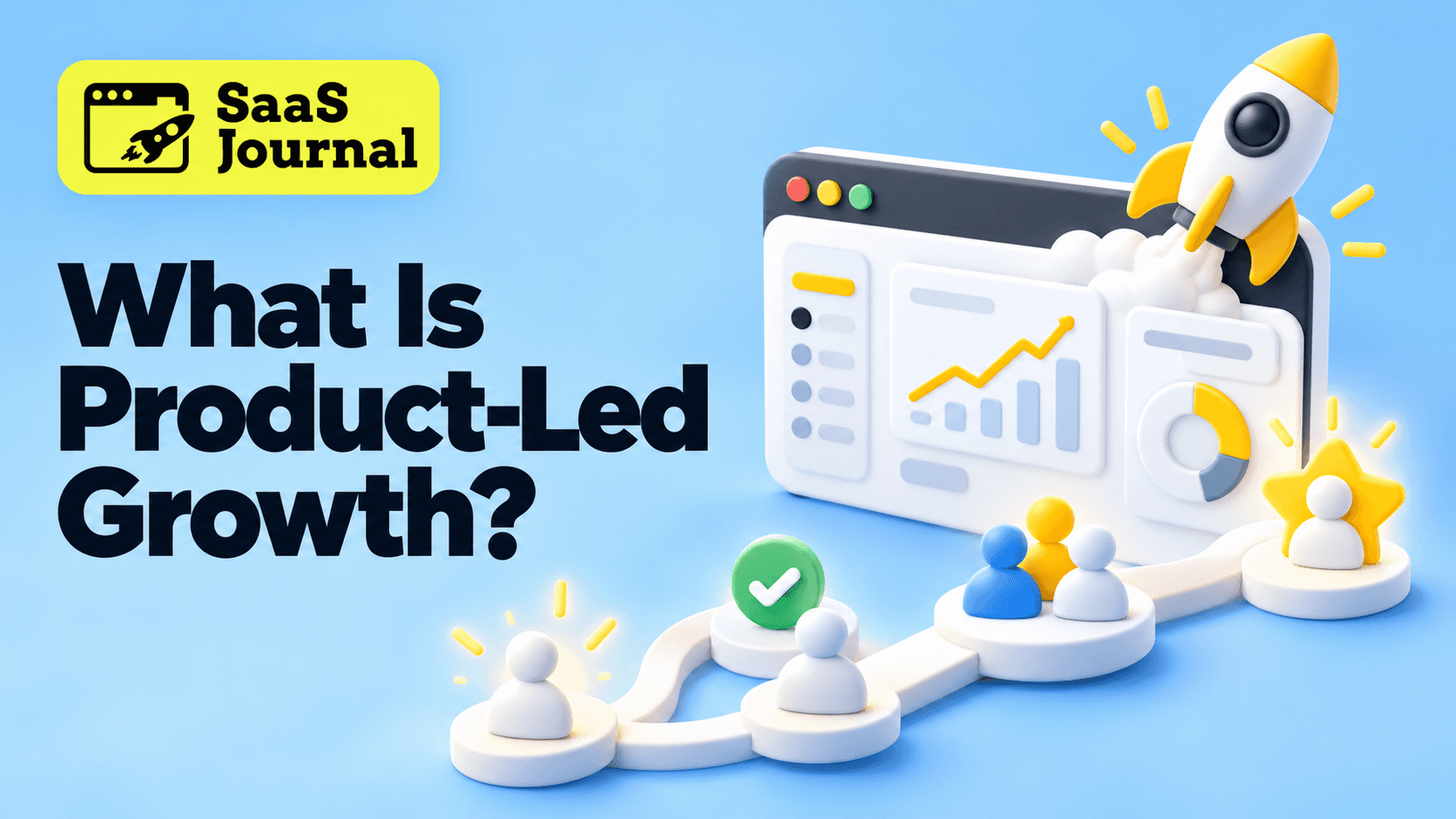
Product-led growth typically follows several stages.
1. Acquisition
Potential customers discover the software through search engines, recommendations, content marketing, social media, or product communities.
2. Activation
Users register and complete an initial action that demonstrates the product's value.
For example, a customer using an email marketing application might create and send their first campaign.
3. Engagement
Customers continue using important features and gradually integrate the software into their workflows.
4. Monetization
Users upgrade when they need additional capabilities, higher usage limits, or premium services.
5. Retention and Expansion
Satisfied customers continue using the software, invite colleagues, or upgrade to larger subscription plans.
These stages are interconnected.
A successful product-led strategy helps users achieve meaningful outcomes throughout the entire customer journey.
Why Product-Led Growth Matters for SaaS Companies
SaaS businesses depend on recurring revenue and long-term customer relationships.
Traditional sales-led approaches can involve expensive customer acquisition processes and significant human involvement.
Product-led growth offers an alternative by allowing customers to evaluate software independently.
Potential advantages include:
-
Reduced friction during registration.
-
Faster access to product value.
-
Lower reliance on sales representatives.
-
Opportunities for organic referrals.
-
Scalable self-service onboarding.
-
Improved visibility into product engagement.
For startups exploring Micro-SaaS opportunities in 2026, product-led strategies can be particularly useful when products are simple enough for customers to understand without extensive assistance.
However, PLG does not automatically reduce customer acquisition costs.
Businesses still need effective distribution, onboarding, customer support, and product development.
Successful product-led growth depends on how consistently users experience value.
Product-Led Growth vs. Sales-Led Growth
Product-led and sales-led growth represent different approaches to customer acquisition.
| Product-Led Growth | Sales-Led Growth |
|---|---|
| Product drives initial adoption | Sales representatives guide adoption |
| Free trials or freemium options are common | Demonstrations and consultations are common |
| Self-service onboarding | Sales-assisted onboarding |
| Users often explore before purchasing | Buyers may evaluate before accessing the product |
| Product usage data informs conversion | Sales interactions inform conversion |
| Common for accessible SaaS products | Common for complex enterprise solutions |
Neither strategy is universally superior.
Some products require detailed demonstrations, security reviews, integrations, or implementation support.
For these businesses, a hybrid approach combining product-led adoption with sales assistance may be more appropriate.
The most effective strategy depends on customer expectations, product complexity, and purchasing requirements.
1. Free Trials and Freemium Models Drive Product Adoption
Free access is one of the most recognizable elements of product-led growth.
However, free trials and freemium models serve different purposes.
Free Trial Model
Customers receive access to the product for a limited period.
For example, a SaaS company might offer a 14-day trial of its project management software.
This approach encourages users to explore paid capabilities before deciding whether to subscribe.
Freemium Model
Customers can use a limited version of the software without a fixed expiration date.
Premium features, higher usage limits, or additional team capabilities require payment.
These limits are concrete, not theoretical. As of November 2026, Slack’s own pricing page describes its free plan as free forever, with messages saved and searchable for 90 days, up to ten app integrations, and huddles limited to one-to-one calls; longer message history and group huddles require a paid plan.
As of November 2026, Dropbox’s plans page lists its free Basic plan with 2 GB of storage, while the paid Plus plan offers 2 TB at $9.99 per month.
As of November 2026, Notion’s pricing page shows a free plan with file uploads capped at 5 MB and 7 days of page history, with the paid Plus plan at $10 per member per month.
In each case the free version is genuinely usable, and the limit that prompts an upgrade grows naturally with usage: message history, storage space, or team features.
Both models can support customer acquisition.
However, businesses must carefully design the free experience.
If the free product provides too little value, users may abandon it.
If it satisfies every customer requirement indefinitely, conversion opportunities may become limited.
The objective is to help users experience genuine value while providing compelling reasons to upgrade.
2. User Onboarding Is Critical to Product-Led Growth
Getting users to register is only the beginning.
The next challenge is helping them achieve their first meaningful outcome.
This is often called the activation stage.
For example, a design application might consider users activated after they create and export their first design.
A CRM platform might define activation as importing contacts and completing an initial sales workflow.
Effective onboarding can include:
-
Simple account registration.
-
Interactive product walkthroughs.
-
Sample projects or templates.
-
Contextual instructions.
-
Progress indicators.
-
Personalized setup recommendations.
Businesses should avoid overwhelming new users with every available feature.
Instead, onboarding should focus on helping customers complete the actions most closely associated with product value.
Amplitude's guide to product activation explains how understanding meaningful user actions can support engagement and retention.
3. Product Analytics Helps SaaS Companies Understand Users
Product-led growth depends on understanding how customers interact with software.
Product analytics can reveal which features users adopt, where they experience difficulties, and what actions are associated with long-term engagement.
Common product metrics include:
-
New user registrations.
-
Activation rate.
-
Feature adoption.
-
Weekly and monthly active users.
-
Trial-to-paid conversion rate.
-
Customer retention.
-
Expansion revenue.
For example, a SaaS company might discover that customers who integrate their email accounts during onboarding are more likely to become paying users.
The company could then simplify that integration process.
However, analytics should be interpreted carefully.
An association between feature usage and retention does not necessarily mean the feature directly causes improved retention.
Companies should use controlled experiments and customer feedback to validate important decisions.
4. Product-Led Growth Can Improve Customer Retention
Customer retention is essential for subscription businesses.
Acquiring customers creates limited long-term value if they cancel shortly after purchasing.
Product-led companies focus on helping users achieve recurring value.
For example, a reporting application might automatically notify customers when new insights become available.
A team collaboration platform might make it easy for users to invite colleagues and share projects.
Retention strategies can include:
-
Relevant product notifications.
-
Personalized educational resources.
-
Feature discovery prompts.
-
Customer feedback collection.
-
Usage-based engagement.
-
Product improvement based on customer needs.
The objective is to make the software useful enough that customers consistently return.
Retention should be measured alongside customer satisfaction and product outcomes rather than relying exclusively on login frequency.
5. Product-Led Growth Creates Expansion Opportunities
One of the strongest advantages of product-led growth is the potential for expansion within existing customer accounts.
A user may begin with an individual subscription and gradually introduce the product to colleagues.
As usage expands, the organization may need additional seats, integrations, security features, or administrative controls.
Common expansion methods include:
Seat-Based Expansion
Customers pay for additional users.
Notion’s paid tiers work this way: as of November 2026, its pricing page lists the Plus plan at $10 per member per month, so revenue grows as a team adds members.
Feature-Based Expansion
Customers upgrade to access advanced capabilities.
Usage-Based Expansion
Subscription costs increase as customers consume more resources.
Team or Enterprise Upgrades
Organizations purchase higher tiers with additional collaboration, security, or administration features.
These models are particularly relevant to SaaS companies seeking sustainable recurring revenue.
Stripe's guide to PLG pricing models explains how pricing structures can support product-led monetization.
However, pricing should remain understandable and aligned with customer value.
Unexpected costs or confusing subscription tiers can damage trust.
6. AI and Automation Are Strengthening Product-Led Growth
Artificial intelligence is creating additional opportunities for product-led SaaS businesses.
AI-powered systems can analyze product usage patterns and support personalized customer experiences.
For example, an AI-assisted onboarding system could identify users who are struggling with a particular feature and suggest relevant tutorials.
Other applications include:
-
Personalized product recommendations.
-
Automated onboarding assistance.
-
Customer churn prediction.
-
Intelligent support chatbots.
-
Feature adoption analysis.
-
Usage-based upgrade suggestions.
These developments align with broader AI and automation in SaaS marketing trends, where businesses increasingly connect customer data with marketing and engagement workflows.
However, automation should improve the customer experience rather than create unnecessary messages or intrusive recommendations.
The best implementations help customers achieve their goals more efficiently.
7. Product-Led Growth Supports International SaaS Expansion
Product-led growth can help software businesses reach customers across geographic markets.
Self-service registration, online payments, and digital onboarding allow customers to evaluate products without requiring local sales offices.
This is especially relevant to Indian SaaS startups scaling to the US market.
A startup can develop software in one country while attracting customers internationally through content marketing, online communities, and product referrals.
Global product-led strategies should consider:
-
Localized pricing.
-
International payment support.
-
Language accessibility.
-
Customer support availability.
-
Data protection requirements.
-
Regional customer expectations.
However, international expansion also introduces tax, compliance, and operational considerations.
Companies should evaluate these requirements before entering new markets.
8. Important Product-Led Growth Metrics
Measuring performance is essential for understanding whether a PLG strategy works.
| Metric | What It Measures |
|---|---|
| Activation Rate | Percentage of users reaching a meaningful first outcome |
| Time to Value | How long users take to experience product benefits |
| Trial-to-Paid Conversion | Percentage of trial users becoming paying customers |
| Customer Acquisition Cost | Cost of acquiring a new customer |
| Customer Retention Rate | Percentage of customers remaining active over time |
| Net Revenue Retention | Revenue retained from existing customers, including expansion and contraction |
| Expansion Revenue | Additional revenue from existing customers |
Amplitude's product-led growth measurement framework emphasizes tracking user activation, engagement, retention, and monetization.
Founders should choose metrics appropriate to their specific products rather than relying on universal benchmarks.
9. Challenges of Product-Led Growth
Despite its benefits, PLG introduces several challenges.
Low Free-to-Paid Conversion
Businesses may attract large numbers of free users without generating sufficient subscription revenue.
Customer Support Requirements
Self-service products still require documentation, troubleshooting resources, and accessible support.
Product Complexity
Some enterprise products cannot demonstrate meaningful value without technical implementation.
Infrastructure Costs
Free users may consume hosting, storage, or AI processing resources without generating revenue.
Weak Customer Activation
Users who register but never experience product value are unlikely to become paying customers.
Addressing these challenges requires balancing accessibility with sustainable business economics.
10. How to Build a Product-Led Growth Strategy
SaaS founders can implement PLG through a structured process.
Step 1: Identify Your Ideal Customer
Determine who benefits most from the software and what problems they need to solve.
Step 2: Define the Product's Core Value
Identify the meaningful outcome customers should experience early.
Step 3: Simplify Registration
Remove unnecessary barriers to accessing the product.
Step 4: Build Effective Onboarding
Guide customers toward their first valuable action.
Step 5: Establish a Monetization Strategy
Choose suitable subscription tiers, usage limits, or premium features.
Step 6: Measure Customer Behavior
Analyze activation, engagement, conversion, and retention.
Step 7: Improve Based on Feedback
Use customer research and experiments to refine the experience.
Step 8: Introduce Sales Assistance When Needed
Support high-value accounts that require demonstrations, security reviews, or implementation guidance.
A successful PLG strategy evolves through continuous learning rather than a single product launch.
The Future of Product-Led Growth in 2026
Product-led growth continues to evolve as SaaS businesses integrate artificial intelligence, automation, and more sophisticated product analytics.
AI-assisted onboarding may help users reach value faster, while behavioral analytics can support more relevant product experiences.
At the same time, businesses are increasingly combining self-service adoption with targeted sales assistance for enterprise customers.
This hybrid approach recognizes that different customer segments have different purchasing needs.
For founders, the central principle remains unchanged: the product must consistently deliver meaningful value.
Companies that simplify adoption, improve customer outcomes, and build sustainable monetization models will be better positioned for long-term growth.
Conclusion
Product-led growth is a powerful SaaS business strategy that places the product at the center of customer acquisition, activation, retention, and expansion.
By allowing users to experience software before purchasing, businesses can reduce adoption friction and create opportunities for scalable growth.
However, successful PLG requires more than free trials or freemium subscriptions.
It depends on effective onboarding, valuable product experiences, customer analytics, thoughtful pricing, and continuous improvement.
For SaaS founders, the goal should be to build software that customers genuinely want to use and recommend.
The most effective product-led businesses do not simply make their products easy to access. They make their products valuable enough that customers choose to stay, pay, and grow with them.