For years, professionals have been told the same thing:
“Make sure your LinkedIn profile is updated.”
That is still good advice.
But it is no longer enough.
The way clients, employers, partners, and potential customers evaluate professionals has changed dramatically. People don't simply read a resume anymore. They search your name, visit your social profiles, look for examples of your work, check your experience, and try to determine whether you are credible before they ever contact you.
In other words, your professional reputation now exists online whether you intentionally built it or not.
The question is:
Are you controlling what people find?
For freelancers, consultants, creators, executives, agency owners, marketers, developers, designers, and other independent professionals, building a centralized digital identity is becoming increasingly important.
That's where tools such as Verified Credential by Marketing Inc are introducing a different approach.
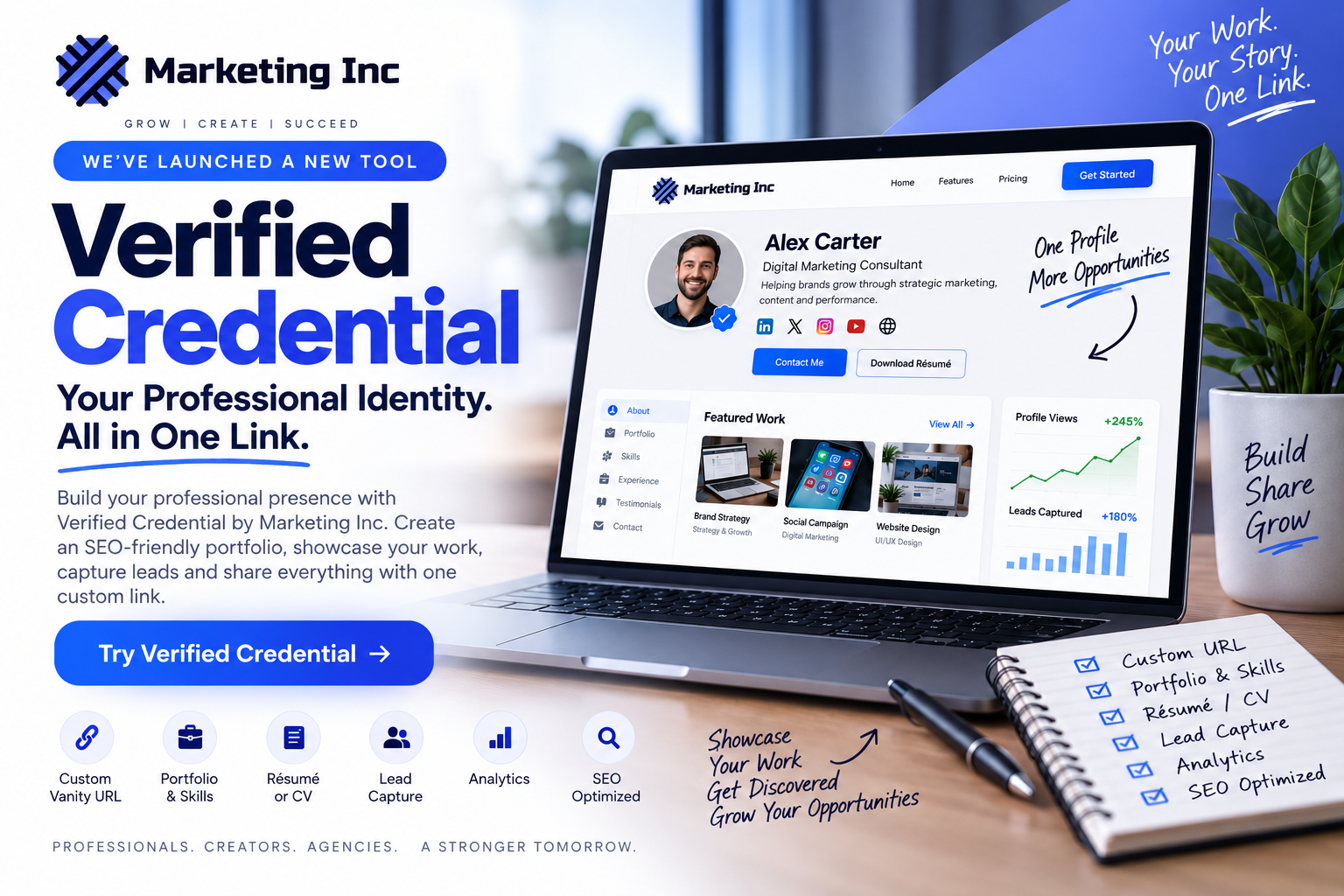
Instead of forcing people to jump between your LinkedIn profile, portfolio, resume, website, social accounts, and contact information, Verified Credential brings these elements together into one professional page.
It is a surprisingly simple idea that addresses a much larger problem: professional credibility has become fragmented across the internet.
The Problem With Your Current Online Presence
Think about your own professional identity for a moment.
Where can someone find information about you?
Maybe LinkedIn.
Maybe Instagram.
Perhaps you have a personal website.
Your portfolio might be hosted somewhere else.
Your resume is probably a PDF sitting on your computer or Google Drive.
Your case studies may live on another website.
Your contact information might be in your email signature.
The information exists.
But it isn't connected.
Now imagine you are a potential client researching a consultant.
You visit their LinkedIn page.
You see their job history, but not much of their work.
So you search Google.
You find their website.
Then you look for case studies.
Then you want to know whether they have experience in your industry.
Then you need their email address.
Every additional step creates friction.
And friction matters when someone is deciding whether to contact you or move on to another professional.
A modern professional profile should make that decision easier.
Personal Branding Is No Longer About Becoming an Influencer
The phrase "personal branding" sometimes gets misunderstood.
People immediately think about posting constantly on LinkedIn, creating videos, growing thousands of followers, or becoming an influencer.
But personal branding is much simpler than that.
Your personal brand is essentially the answer to three questions:
Who are you?
What are you good at?
Why should someone trust you?
You don't need 100,000 followers to answer those questions.
You need clarity and evidence.
If someone searches for you after receiving a referral, attending a meeting, reading one of your articles, or seeing your name in an email, they should quickly understand your professional value.
That is where a dedicated professional profile becomes useful.
Instead of depending entirely on social networks to communicate your professional identity, you create a centralized destination that you control.
LinkedIn Is Powerful, But It Wasn't Designed to Be Your Entire Professional Identity
LinkedIn is one of the most valuable professional networking platforms in the world.
It is excellent for networking, recruiting, content distribution, prospecting, and professional discovery.
But LinkedIn has a specific purpose.
It is a social network.
Your professional portfolio has a different purpose.
It should be designed around you.
When someone lands on your portfolio, you should determine what they see first.
Maybe that's your expertise.
Maybe it's your strongest case study.
Maybe it's a major project.
Maybe it's your technical skills.
Maybe it's a professional achievement.
The experience shouldn't depend entirely on the structure of a third-party social network.
This is why more professionals are beginning to think about their online presence in layers.
LinkedIn can help people discover you.
Social media can help people engage with you.
Your content can demonstrate expertise.
But your professional page can become the place where all of those signals come together.
One Professional Link Changes How You Network
Imagine attending an industry event.
You meet a potential client.
They ask:
"Can you send me some information about what you do?"
Traditionally, you might send several things.
Your LinkedIn profile.
Your company website.
A PDF resume.
A portfolio.
Maybe a case study.
That's a lot of information.
Now imagine saying:
"Absolutely. Here's my professional profile."
One link.
They open it and immediately see your background, skills, portfolio, resume, contact information, and social profiles.
That link can follow you everywhere.
Put it in your email signature.
Add it to your LinkedIn profile.
Place it in your Instagram bio.
Include it in proposals.
Add it to your resume.
Use it on business cards.
Include it in speaker bios.
Send it after networking events.
Use it in cold outreach.
Add it to your freelance profiles.
The easier you make it for people to understand your work, the easier it becomes for them to remember you.
Your Portfolio Should Prove Your Skills
One of the biggest problems with traditional resumes is that they are based primarily on claims.
"Experienced digital marketer."
"Full-stack developer."
"AI consultant."
"Brand strategist."
"UX designer."
Those descriptions tell someone what you believe you are good at.
But they don't necessarily prove it.
Modern buyers increasingly want evidence.
A potential client doesn't simply want to know that you design websites.
They want to see websites you designed.
They don't simply want to know that you build AI products.
They want to see examples.
They don't simply want to know that you understand marketing.
They want to see campaigns, results, or case studies.
That's why portfolios are becoming relevant far beyond traditional creative professions.
Developers need portfolios.
Consultants need case studies.
Marketers need campaign examples.
Fractional executives need accomplishments.
AI professionals need projects.
Writers need samples.
Independent professionals increasingly need some form of proof.
A platform like Verified Credential combines that proof with the rest of your professional information.
Instead of separating your claims from your evidence, you can present them together.
Your Resume Still Matters — It Just Shouldn't Stand Alone
The resume isn't disappearing.
It is simply becoming one part of a larger professional identity.
There are situations where someone still wants the traditional document.
Recruiters need it.
Hiring managers request it.
Clients sometimes want to understand your complete background.
Organizations may need it for procurement or vendor qualification.
The problem is treating the resume as your only professional marketing asset.
Verified Credential allows users to upload a resume or CV that visitors can access alongside the rest of the professional profile.
That creates an interesting balance.
Visitors who want the quick version can browse your professional page.
Visitors who want detailed career information can access your resume.
And visitors who want evidence can explore your portfolio.
Different visitors get the information they need without requiring you to send multiple resources.
Your Professional Profile Should Generate Business
Here is where things become especially interesting for freelancers and consultants.
A professional portfolio shouldn't simply look good.
It should help generate opportunities.
Think about traditional portfolio websites.
A potential client visits.
They browse a few projects.
Maybe they are impressed.
Then what?
Sometimes there is a contact page.
Sometimes there isn't.
Sometimes the visitor leaves and disappears completely.
Verified Credential includes lead capture directly within the professional profile.
That means your portfolio can function as part of your sales funnel.
A visitor isn't simply looking at your experience.
They can become a lead.
For consultants and freelancers, that's an important distinction.
Your professional profile moves from being a digital business card to becoming a business development asset.
Personal Branding Should Be Measurable
Businesses measure their websites.
They monitor traffic.
They track leads.
They analyze conversion rates.
They identify their strongest acquisition channels.
Yet most professionals know almost nothing about the performance of their own digital presence.
How many people viewed your portfolio last month?
Did anyone visit your professional page after your conference presentation?
Are people clicking the link in your email signature?
Did your recent LinkedIn activity generate interest in your professional profile?
Verified Credential includes analytics for profile views and leads, giving professionals visibility into how their profile is being used.
That might sound like a small feature.
But it represents a larger shift.
Professionals are beginning to manage their careers more like businesses manage brands.
And once you think about yourself as a professional brand, analytics make sense.
Search Engines Are Part of Your Professional Reputation
There is another reason to build a centralized professional profile:
Google.
Search your own name.
What appears?
Ideally, someone searching for you should find information that accurately represents your current professional identity.
But search results can be messy.
An old social account might appear.
A previous employer's page might rank.
An outdated profile could surface.
Or perhaps there isn't much information about you at all.
Creating an SEO-optimized professional profile gives search engines another structured page associated with your identity and expertise.
Verified Credential specifically includes an SEO-optimized profile as part of its offering.
Of course, creating a page does not guarantee rankings. Search engines evaluate numerous factors when determining results.
But creating high-quality, structured information around your professional identity is still a sensible component of personal SEO.
This becomes even more valuable when someone searches for your name alongside your profession.
For example:
"Michael Johnson SaaS consultant"
"Priya Shah AI developer"
"Emily Davis marketing strategist"
"Robert Wilson fractional CFO"
Those searches can happen after someone hears about you through a referral.
The person searching already knows your name.
Now they're evaluating your credibility.
Your professional page can help answer their questions.
A Custom Professional URL Makes You Easier to Remember
URLs are easy to underestimate.
A random profile URL filled with numbers and characters isn't particularly memorable.
A custom vanity URL feels more intentional.
Verified Credential provides users with a custom professional URL that can be shared across channels.
This is especially useful when networking offline.
A memorable professional link can be included on a business card, QR code, presentation, event badge, or printed material.
The objective is simple:
Make it easy for someone to find you again.
Because networking often doesn't fail during the initial conversation.
It fails afterward.
Someone meets you.
They intend to follow up.
Three days pass.
They can't remember your company name.
They search your name and get distracted.
The connection disappears.
Giving people a single professional destination reduces that friction.
What Does Verified Credential Cost?
Marketing Inc has positioned Verified Credential with a low-cost introductory offer.
For individual freelancers and consultants, Verified Credential costs $1 for the first month and then $199 per year.
The subscription currently includes:
- Verified professional profile page
- Custom vanity URL
- Portfolio and skills showcase
- Resume/CV upload and download
- Lead capture from profile visitors
- Analytics for profile views and leads
- Social links and contact information
- SEO-optimized professional profile
The subscription automatically renews and can be canceled anytime.
For someone who would otherwise build and maintain a separate personal website, connect analytics, install contact forms, purchase hosting, and manage portfolio software, having those capabilities consolidated into one platform could be compelling.
And the $1 first month makes it possible to build the profile and evaluate whether the format works for your professional brand before committing to the annual subscription.
What About Agencies?
Marketing Inc has also created an Agency Hub for digital marketing agencies and professional firms.
It follows a similar concept but adapts it to an organization rather than an individual.
The Agency Hub costs $1 for the first month and then $499 per year.
Instead of focusing on an individual's resume and skills, Agency Hub includes features designed around agency credibility and client acquisition.
These include an agency profile, custom agency URL, team and services showcase, case studies and portfolio functionality, client lead capture and CRM, agency analytics, award and recognition displays, and SEO optimization.
This makes sense because agencies experience many of the same problems as freelancers.
Prospective clients want evidence.
They want to understand services.
They want to see previous work.
They want to understand the team.
And ultimately, they need a clear way to start a conversation.
Who Needs a Verified Professional Profile?
Not everyone needs another online profile.
But professionals whose income depends heavily on their expertise and reputation should consider how their digital identity appears to potential customers.
That includes:
Freelancers.
Consultants.
Developers.
Designers.
Marketing professionals.
AI specialists.
Writers.
Creators.
Fractional executives.
Photographers.
Coaches.
Advisors.
Agency owners.
Sales professionals.
Independent experts.
For these professionals, credibility isn't simply part of marketing.
Credibility is the product before the product.
Before someone buys your consulting, hires you for a project, signs an agency contract, or invites you into an organization, they are buying confidence in your ability to deliver.
Your online presence plays a role in creating that confidence.
You Don't Need More Profiles. You Need One Better Destination.
The internet doesn't have a shortage of places where you can create an account.
What professionals need is something different.
They need clarity.
One place that explains who they are.
One place that showcases their best work.
One place that provides their professional history.
One place where prospects can contact them.
One link they can confidently share.
That is the underlying value proposition behind Marketing Inc's Verified Credential.
It isn't about replacing LinkedIn.
It isn't necessarily about replacing your website.
It isn't about eliminating your resume.
It is about connecting the pieces.
Because the future of professional reputation probably won't revolve around a single platform.
Your identity will continue to exist across search engines, social networks, professional communities, websites, podcasts, articles, events, and countless other places.
What matters is having somewhere to send all of that attention.
Your Name Is Already a Search Term
Whether you're intentionally building a personal brand or not, your name is already part of your digital identity.
Potential clients search it.
Recruiters search it.
Investors search it.
Business partners search it.
Customers search it.
People you meet at conferences search it.
The only question is what happens after they do.
Do they find scattered information?
An outdated social profile?
A generic LinkedIn page?
Or do they find a professional presence that clearly communicates what you do and why you're credible?
That's why building a digital professional identity is becoming less about vanity and more about infrastructure.
A strong professional presence should make you easier to discover.
It should make your expertise easier to understand.
It should make your work easier to evaluate.
And it should make you easier to contact.
If you're a freelancer or consultant who wants to bring those pieces together, you can explore Verified Credential from Marketing Inc and create a profile starting at $1 for the first month.
Because your next opportunity may begin with a referral, an introduction, a LinkedIn post, or a conversation.
But increasingly, what happens next is the same.
Someone searches your name.
Make sure what they find helps you.